
After a North Texas storm, keep people away and arrange prompt help if a tree has hanging limbs, a newly split trunk, a changed lean, lifting roots, fresh soil cracks, or branches touching a structure or utility line. Do not stand beneath damaged branches or try to pull down wood under tension. A tree can remain standing while its trunk, branch unions, or root system have been weakened, so compare it with how it looked before the storm and recheck it after the ground dries.
High wind, hail, lightning, and rain-saturated soil can damage different parts of a tree at the same time. Some failures are obvious. Others appear as a narrow crack, raised soil, torn bark, or a branch caught high in the canopy. The goal of a homeowner inspection is not to declare a tree safe; it is to recognize warning signs, protect the area, and communicate what changed.
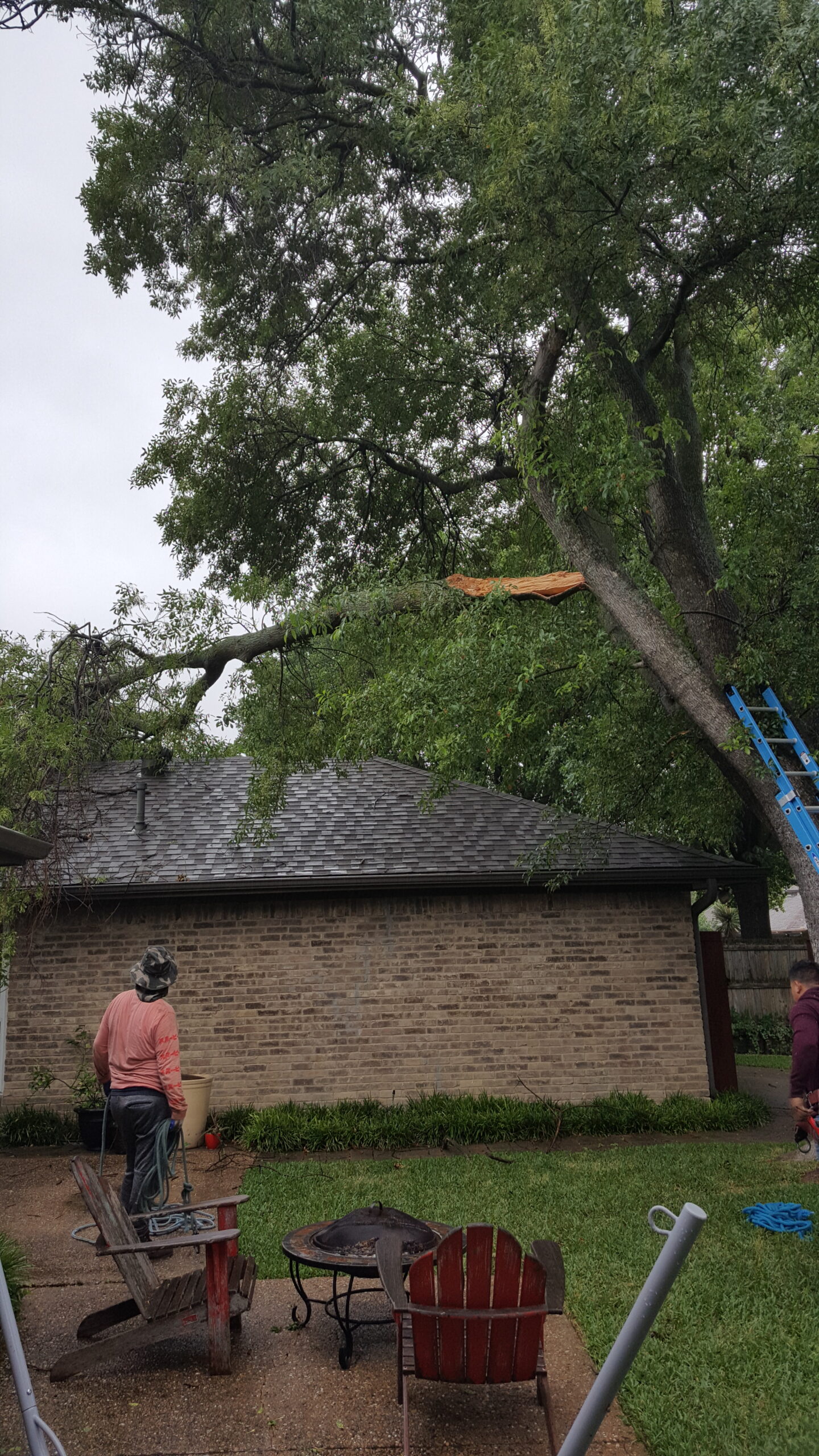
What Should You Do First After the Storm?
Wait until the severe-weather threat has passed and inspect only from stable ground. The National Weather Service recommends continuing to monitor local warnings, wearing sturdy clothing and shoes around storm debris, and contacting local authorities about downed power lines.
- Look for wires before approaching trees or debris. A fallen line can energize a tree, fence, vehicle, wet ground, or nearby object. Stay away and contact the utility or emergency authorities.
- Create distance from anything overhead. Keep family members, pets, vehicles, and neighbors out of the potential fall area around hanging or partially attached limbs.
- Compare the tree with its pre-storm position. A lean that has always existed is different from a new lean accompanied by cracked soil or root movement.
- Photograph from safe angles. Capture the whole tree, trunk base, damaged union, nearby targets, and any contact with a roof or fence without walking underneath the defect.
- Do not test the damage. Pulling a limb, climbing the tree, using a ladder, or cutting loaded wood can release stored force without warning.
Wind and saturated clay soil can create a delayed root problem
A tree may still look upright after straight-line winds, but rain-softened soil can allow the root plate to shift. Watch for newly raised soil, a depression on the opposite side of the trunk, widening ground cracks, or exposed roots. These changes matter most when the tree can reach a home, driveway, sidewalk, neighboring property, or utility corridor.
Seven Warning Signs of a Hazardous Storm-Damaged Tree
1. Broken, hanging, or lodged branches
A branch does not need to reach the ground to be dangerous. Look for snapped limbs still attached by bark, branches resting on lower limbs, and broken wood caught in a neighboring tree. Wind can move or release these pieces after the storm.
2. A fresh trunk crack or split branch union
Inspect the trunk and major unions from multiple safe viewpoints. Fresh pale wood, torn bark, a widening seam, or two stems pulling apart can indicate loss of structural support. A full green canopy does not cancel a crack below it.
3. A new or increasing lean
Compare the trunk with fences, rooflines, old photographs, or your memory of its normal position. A changed lean is more concerning when paired with root movement, a cracked trunk, or a heavy canopy now directed toward a target.
4. Root plate movement or lifting soil
Look around the base without stepping into the likely fall path. Freshly exposed roots, mounded soil, a new gap beside the trunk, or cracks radiating through the lawn may show that anchoring roots moved in wet soil.
5. Torn bark, cavities, or exposed decay
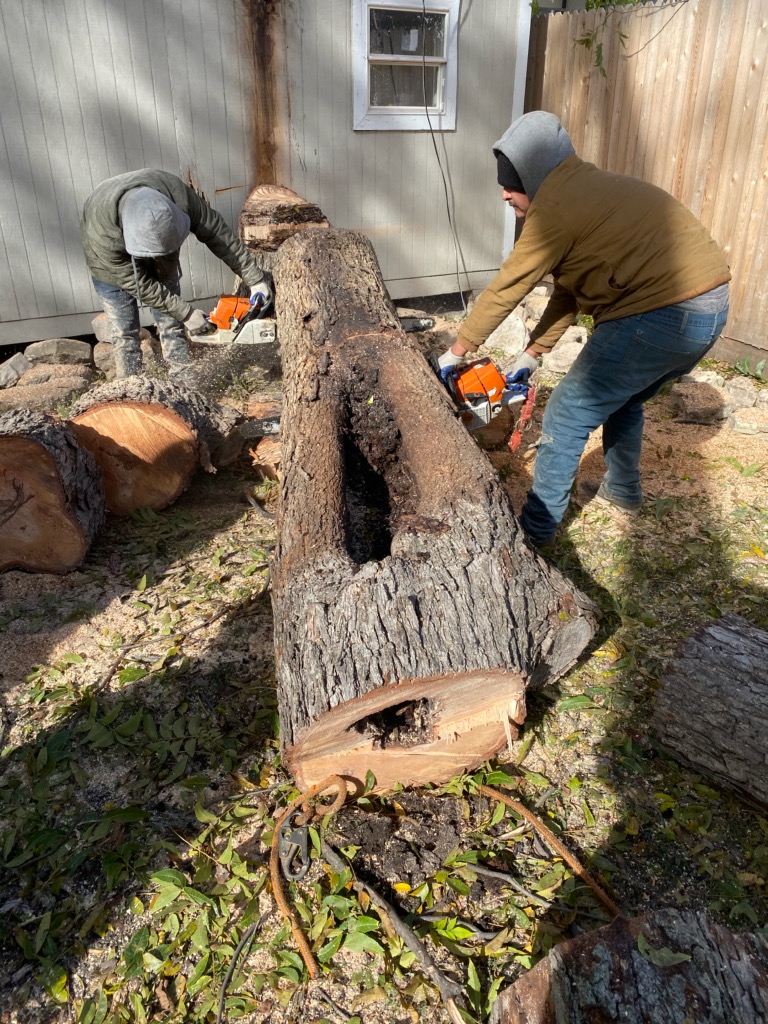
Storms often reveal a weakness that existed before the weather arrived. Missing bark, hollow areas, fungal growth, old cavities, and soft or dark wood near a fresh break can reduce the amount of sound wood supporting the tree.
6. A suddenly uneven or unbalanced crown
When one major side of the canopy fails, the remaining tree may carry weight differently. The original break, the condition of the trunk and roots, and the direction of the remaining branches all affect whether corrective pruning can restore an acceptable structure.
7. Damage near a target
Tree risk depends on both the likelihood of failure and what could be struck. The same defect requires greater urgency over a bedroom, street, play area, parked car, pool, or frequently used walkway than it would in an isolated area where access can be restricted.
How Urgent Is the Damage?
| What you see | Immediate action | Why it matters |
|---|---|---|
| Tree or branch touching a power line | Stay well away and contact the utility or emergency authorities. Do not touch the tree or nearby objects. | The tree, wet ground, fence, or equipment may be energized. |
| Hanging limb, split trunk, active root lifting, or tree on a structure | Clear the area and request urgent professional assessment. | The damaged wood may move without warning, especially in wind. |
| Broken limb with a stable trunk and roots | Keep the area clear and schedule assessment and corrective pruning. | The whole tree may be preservable, but the break and remaining structure need review. |
| No obvious damage, but the tree took strong wind or nearby trees failed | Perform a careful ground-level comparison now and again after the soil dries. | Cracks, canopy dieback, and root instability can become clearer later. |
Can a Storm-Damaged Tree Be Saved?
Sometimes. A broken branch does not automatically require removing the entire tree, and a tree should not be judged by one canopy percentage alone. The decision depends on where the failure occurred, whether the remaining trunk and roots are stable, the tree’s prior condition, and what could be hit if another part fails.
| Preservation may remain practical when | Removal may be the safer recommendation when |
|---|---|
| Damage is limited to removable branches and sound attachment points remain. | The main trunk or a critical co-dominant union is split through structural wood. |
| The trunk base and root plate show no movement. | Roots have lifted, broken, or lost anchorage and the tree has developed a new lean. |
| The remaining crown can be balanced without topping or excessive live-canopy loss. | Too little sound structure remains to support a viable, reasonably balanced crown. |
| Decay is localized and not controlling a major load-bearing area. | Extensive decay or a cavity compromises the trunk, base, or primary branch union. |
Possible responses include removing damaged branches, reducing weight on a specific limb, installing an engineered support system in an appropriate tree, restricting the target area, monitoring changes, or completing controlled tree removal. Support hardware is not a guarantee against failure and requires inspection, so it should follow a qualified assessment rather than a quick visual guess.
Why a Tree May Fail After the Sky Clears
Storm damage can continue to develop. A partly attached branch may dry, twist, and release later. Roots shifted in saturated soil may lose more support as wind returns. A narrow crack can expand as the remaining canopy moves. Lightning injury or torn bark may also lead to decline that is not visible on the first day.
Recheck the tree after the ground begins to dry and again after the next windy period. Look for a growing lean, new soil cracks, wilting or premature leaf loss on one side, falling bark, expanding trunk seams, or small branches dropping from an area that previously looked intact. Keep dated photos so changes are easier to compare.
What Storm Cleanup Is Safe for a Homeowner?
Picking up small debris from open ground may be reasonable once power and overhead hazards are ruled out. Large storm-damaged wood is different. Avoid:
- Working from a ladder with a chainsaw or pole saw. The branch can swing, roll, or knock away the ladder as fibers release.
- Cutting bent or loaded limbs. Wood under tension may spring or split toward the operator.
- Walking beneath lodged branches. The piece may be supported by very little sound wood.
- Handling anything near utility lines. Contact the utility and keep others away.
- Hiring on urgency alone. Ask for written scope, cleanup details, insurance information, and an explanation of why removal or pruning is recommended.
Harvest provides emergency tree service, corrective pruning, and removal across McKinney and surrounding North Texas communities. The safest scope should address the defect without removing more healthy tree than the situation requires.
Special Note for Storm-Damaged Oaks
Wind can create fresh wounds on oaks even when no pruning has occurred. Texas Oak Wilt guidance recommends painting fresh oak wounds, damaged surface roots, and pruning cuts immediately throughout the year. Safety still comes first: do not approach a damaged oak beneath unstable branches or near electrical lines merely to paint a wound.
How Should You Document Storm Damage?
Before cleanup changes the scene, photograph damage from safe locations. Include the whole tree, the failed branch or trunk, root area, impacted structure, and surrounding property. Record when the damage was discovered and avoid making claims about insurance coverage; policies and circumstances vary. Your insurer can explain required documentation and whether emergency mitigation should proceed before an adjuster visits.
Frequently Asked Questions
Is a leaning tree always dangerous after a storm?
Not every naturally leaning tree is unstable. A new or increasing lean, especially with lifting roots, mounded soil, a trunk crack, or a target in its path, warrants urgent assessment.
Can a tree look healthy and still be hazardous?
Yes. Green leaves do not confirm structural integrity. Cracks, decayed unions, broken roots, and suspended branches can exist beneath an otherwise full canopy.
Does one broken limb mean the whole tree must be removed?
No. If the trunk, root system, and remaining major branches are sound, corrective pruning may be sufficient. Damage at a primary union or through a decayed trunk can change that recommendation.
How long after a storm can a damaged tree fail?
There is no reliable countdown. Failure can occur during the storm, shortly afterward, or later as wind, drying wood, saturated soil, and existing defects interact. Restrict access around visible hazards until they are assessed.
Should I inspect trees again if they looked fine the next morning?
Yes. Recheck them after the soil dries and after later wind. Compare dated photos for changes in lean, soil cracks, trunk seams, bark, and canopy condition.
Who should handle a tree touching a power line?
Keep everyone away and contact the electric utility or emergency authorities. Do not touch the tree, branch, fence, vehicle, standing water, or equipment near the line.
Storm Safety and Tree-Risk Resources
- National Weather Service post-storm safety guidance covers ongoing warnings, protective clothing, damage assessment, and downed power lines.
- International Society of Arboriculture tree-risk guidance explains targets, storm response, pruning, support systems, monitoring, and removal options.
- Texas Oak Wilt management guidance addresses fresh storm wounds and immediate wound painting for oaks.